Androgenetic alopecia
Hereditary hair loss in men and women. Caused by DHT shrinking follicles at the temples and crown. Affects 80% of men and 50% of women at some point in life.
Hair loss is common and affects, at some point in life, a majority of men and half of all women. Almost all types can be treated, but the right strategy requires the right diagnosis. Here we go through everything you need to know.

hair conditions we cover, one by one, further down the page
of men experience hereditary hair loss at some point in life
of women notice visible hair loss after the age of 40
hairs per day is normal to shed, more can be a warning sign
Hereditary hair loss in men and women. Caused by DHT shrinking follicles at the temples and crown. Affects 80% of men and 50% of women at some point in life.
Temporary, diffuse hair loss after stress, illness, weight loss or childbirth. Usually recovers naturally in 6-9 months once the underlying cause is managed.
Autoimmune. Round bald patches appear suddenly. Requires medical assessment by a dermatologist before transplantation can be considered.
Permanent hair loss after accidents, surgery, burns or skin conditions. Often treated effectively with a hair transplant.
Postpartum, menopause, PCOS or thyroid issues. Often treated with PRP or medication before surgery is considered.
Caused by tight hairstyles (tight ponytails, dreadlocks, extensions). Reversible early on, permanent with long-term use.
By far the most common cause. Gene variants determine how sensitive your follicles are to DHT (dihydrotestosterone).
Severe stress, illness or surgery can trigger telogen effluvium, diffuse hair loss appearing 2 to 3 months after the event.
Pregnancy, menopause, thyroid issues and PCOS affect the growth cycle of the hair follicle.
Blood-pressure, antidepressant and blood-thinning medications can cause shedding as a side effect. Usually reverses when treatment ends.
Iron, vitamin D, zinc, biotin and protein are central to hair growth. Deficiency can cause diffuse hair loss.
Tight headwear, heat, chemical treatments and pulling hairstyles damage follicles mechanically.
The right treatment requires the right diagnosis. At a free consultation we review your medical history, photo-document the hair loss and assess follicle status in the recipient and donor area.
When needed we refer you to a dermatologist for medical evaluation before any treatment begins. We never start a transplant on an unclear diagnosis.
Book free consultation
We do hair transplants and PRP treatment to address hair loss on the scalp, beard, eyebrows and scars. We only work with these two methods because they have documented effect, high safety and produce natural results using the body's own resources.
A hair transplant is used for permanent hair loss or when you have naturally sparser hair growth. With us you can choose the DHI or FUE technique for sparse growth on the scalp or beard. For eyebrow or scar transplants we only use the DHI technique.
PRP injections are used both as a complement to a hair transplant and as a stand-alone treatment for temporary hair loss or early signs of permanent hair loss. With us you can choose PRP on a whole area with hair or targeted at specific zones where the follicles need extra support.
Which treatment fits depends on whether the follicles are still active or have stopped producing hair.
Hair transplantation (FUE or DHI), Used for permanent hair loss. Follicles are moved from the back of the head or the sides to areas where hair growth has stopped. The relocated follicles continue to grow naturally and permanently.
PRP treatment, Suitable for early or temporary hair loss. The treatment is natural because it uses the body's own growth factors from blood plasma to stimulate the follicles.
Medication, There are medications that can slow hair loss and strengthen existing strands. They are mainly used for temporary or early hair loss, when the follicles are still active. Finasteride is used by men and requires a medical assessment, while minoxidil can be used by both men and women and is available over the counter at pharmacies. We do not prescribe these, but we are happy to explain how they work and what may be relevant in your case.
Non-surgical solutions, In some cases other options may be more suitable than medication, hair transplantation or PRP. This may be the case if you have too little hair left to move, or if illness or medical conditions mean you are not a candidate for the other treatments. Hair pieces, toppers or scalp micropigmentation (SMP) can then be good alternatives to create a fuller or more even overall appearance.
Guidance for hair loss
At your consultation we go through which option fits you best, based on your hair type, the cause of your hair loss and what you want to achieve.
Both hair transplants and PRP are low-risk treatments. Most reactions are mild and resolve within a few days.
We work with sterile instruments, medically trained personnel and clear hygiene instructions after every treatment.
You receive follow-up and support during healing to ensure a safe and secure result.
We always inform you of the risks before each treatment and are available if you have questions or notice anything out of the ordinary.
Book consultation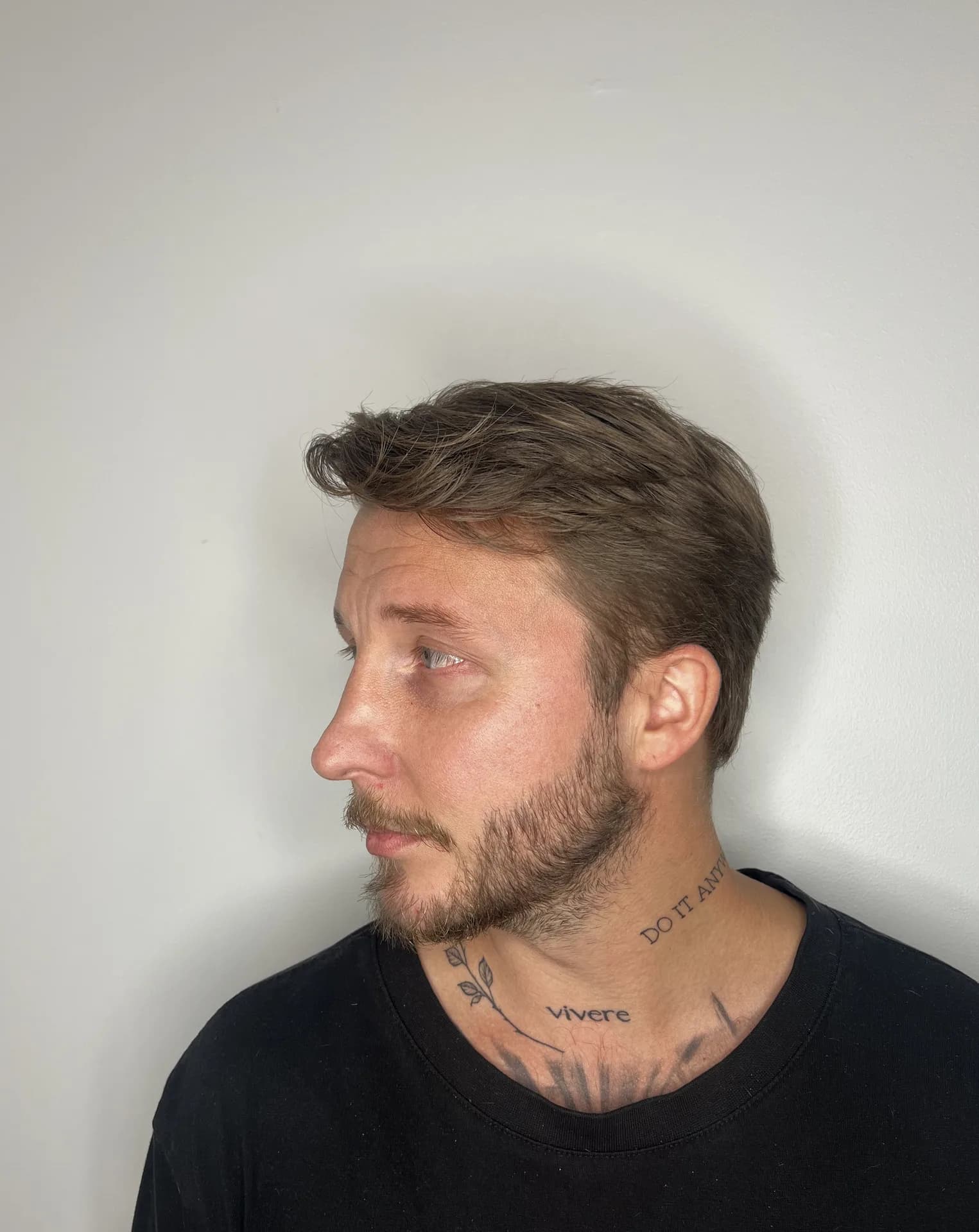
Want to fill a gap in your beard, shape your moustache or get a denser overall look? We move follicles from the nape or back of the head and place them in the beard area with the right angle and direction for natural beard fall.
Beard transplant in short:
We rebuild shape and fullness in the eyebrows by placing follicles in the right direction for the inner, middle or outer part of the brow, adapted to your facial features.
Permanent solution for hereditary hair loss. Individual follicles are taken from the donor area and placed where the hair has thinned.
Read about FUEModern technique with the Choi pen for precise control of angle and density, especially for hairlines, beards and eyebrows.
Read about DHINatural method using your own blood plasma to stimulate the follicles. Slows hair loss and strengthens existing growth.
Read about PRPMicrochannels in the scalp increase the permeability for PRP and growth factors. A strong complement to PRP.
Read about microneedlingEach condition has its own causes, symptoms and treatment options. Here we cover them in detail, so you can understand your situation before booking a consultation.
The most common form of hair loss in both men and women, caused by a genetic sensitivity to the hormone DHT.
Read moreHair conditionOne of the first visible signs of hereditary hair loss in men, the hairline recedes at the temples and forms an M shape.
Read moreHair conditionHair that has become sparser and lost volume across the whole head, often without a clear bald spot, common with both hereditary and temporary causes.
Read moreHair conditionThinning and bald patches at the crown/whorl, a classic sign of hereditary hair loss that often begins at the same time as the temples recede.
Read moreHair conditionAn autoimmune condition causing sudden, round bald patches in the scalp or beard. Treated medically, not with a transplant during the active phase.
Read moreHair conditionA temporary, diffuse hair loss where many follicles enter the resting phase at once, often after stress, illness, childbirth or weight loss.
Read moreHair conditionHair loss caused by prolonged pulling on the hair, tight updos, braids or extensions. Most common along the hairline and temples.
Read moreHair conditionPermanent hair loss where the follicles have been replaced by scar tissue, after injury, burns, surgery or certain skin diseases.
Read moreHair conditionHair loss in women usually shows as diffuse thinning with a wider part, while the hairline is preserved. The causes are often several at once.
Read moreHair conditionAn irritated scalp rarely causes permanent hair loss, but untreated inflammation and itching can hinder hair growth and should be taken seriously.
Read moreHair conditionBoth an under- and overactive thyroid can cause diffuse hair loss. It is usually reversible once thyroid levels are normalised.
Read moreHair conditionLow iron stores (low ferritin) are one of the most common hidden causes of hair loss, especially in women. Usually reversible once iron is replenished.
Read moreHair conditionIn PCOS, raised levels of male hormones can cause female-pattern hair loss, thinning at the crown and a wider part, often together with increased facial hair.
Read moreHair conditionA scarring, slowly progressing form of hair loss that pulls the hairline back in a band around the forehead, most common in women after menopause. Requires a dermatologist.
Read moreHair conditionMany people experience heavy hair loss a couple of months after covid or another febrile illness. It is a form of telogen effluvium, almost always temporary.
Read moreHair conditionHeavy hair loss a few months after childbirth is common and completely normal. It is due to hormonal changes and almost always resolves on its own.
Read moreHair conditionA condition where a person repeatedly pulls out their own hair, often unconsciously. It is treated primarily psychologically, with the right support it can be overcome.
Read moreWe want you to feel confident in your choice. We answer your questions and show how a treatment can be performed, completely free of charge.